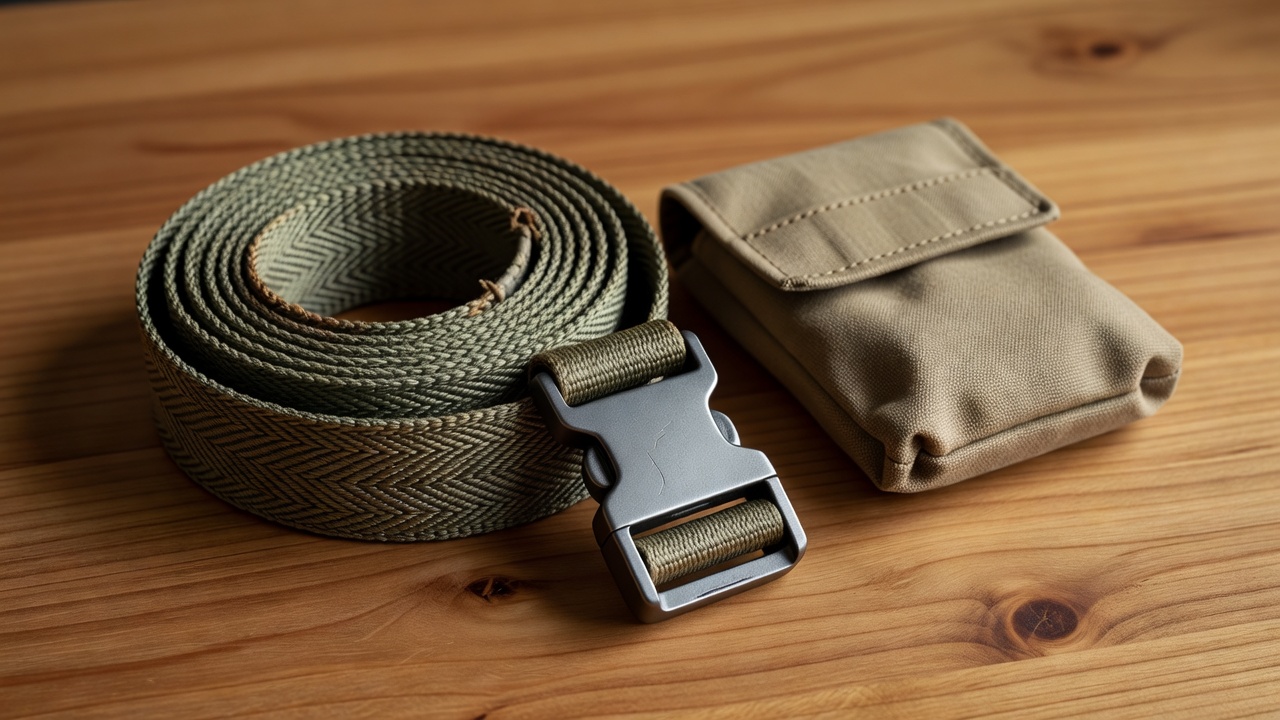
Begin where hands and surfaces meet
On a daily route, the same few details do most of the work. You grip a pull tab, adjust a strap, set a pouch on a desk and slide a device into a sleeve. These repeated contacts reveal more about an accessory’s usefulness than an attractive product photograph. Consider what rubs, bends, gets wet and carries weight in your own routine.
Choose accessories to solve a specific problem. A key loop can reduce searching; a sleeve can separate a device from hard objects; a bottle strap can make handling easier. None is automatically necessary. Adding an attachment creates another connection that can loosen, catch or interfere with access. The improvement should be clear enough to justify that extra part.
Read material descriptions carefully
Nylon, polyester, canvas and leather describe broad material categories, not finished performance. Fibre quality, weave, thickness, finish and construction all influence how an item behaves. Denier describes linear fibre mass; it is not a universal durability score. A higher number on a listing does not, by itself, establish better abrasion resistance or a longer useful life.
Coatings can change water resistance and handling, but they also introduce care requirements. Some finishes age through peeling, tackiness or cracking. Leather can vary widely in finish and maintenance needs; waxed canvas may require compatible treatment. Ask what care the maker recommends and whether that care is realistic for you before buying into a material story.
| Material or part | Ask about | Inspect in use |
|---|---|---|
| Woven fabric | Composition, weave and coating | Rubbing at corners and folds |
| Webbing | Width and hardware compatibility | Slippage, fraying and sharp edges |
| Zip | Repair route and replacement access | Alignment, trapped fabric and stressed ends |
| Coated surface | Cleaning limits and care instructions | Peeling, cracking or a changing feel |
Examine hardware as a system
A buckle is useful only when it matches the webbing and the load involved. Check the stated size, adjustment path and attachment arrangement. A replacement may need a split attachment bar or sewing access; a visually similar part is not necessarily compatible. For any safety-critical use, only use components rated and approved for that application.
Metal does not always outperform polymer. Metal can add weight, scratch nearby objects or become uncomfortable against the body. Polymer can be lighter but may crack or deform depending on composition and conditions. Construction, intended use and available replacements are more informative than choosing a material as a status signal.
Likewise, a branded zipper is not a guarantee that an entire pouch will last. Track alignment, stitching, corner geometry and how tightly the contents are packed all matter. If closing the item consistently requires force, reduce the load or choose a better-fitting format rather than treating resistance as normal.
Make repair a question you can answer
Before buying, ask what happens if the most exposed component fails. Can the pull tab be replaced? Is a strap removable? Can a local repairer reach the seam? Does the manufacturer assess repairs, supply parts or publish useful instructions? A repairable design needs both physical access and a realistic route to suitable materials and workmanship.
Repair promises should be read alongside exclusions, shipping arrangements and likely costs. A warranty may cover a manufacturing fault without covering ordinary wear, accidental damage or unauthorised modification. Save your purchase record and care instructions. Do not assume that “lifetime” has the same meaning across brands or products.
Distinguish evidence from broad claims
Environmental and durability language should be specific enough to check. Ask which part contains recycled content, what percentage is claimed and what evidence supports it. A certification usually has a defined scope; it does not establish every desirable property of a finished item. For example, OEKO-TEX STANDARD 100 concerns testing for harmful substances, not proof that a bag is waterproof or repairable.
Similarly, the Nordic Swan Ecolabel and the EU Ecolabel operate through defined product criteria. Check whether the actual product carries a valid label and what that label covers. A shop using nature imagery or the word “Nordic” is not equivalent evidence.
Keep care proportionate and repeatable
Empty the accessory before cleaning and follow its care label. Brush out loose dirt where appropriate, test permitted cleaners discreetly and dry the item as instructed. Avoid improvised solvent treatments or heat unless the manufacturer explicitly permits them. Store clean, dry gear without crushing vulnerable components or leaving heavy contents hanging from small loops.
Finally, inspect rather than replace on a fixed aesthetic schedule. A scuffed surface can remain serviceable; a nearly invisible damaged attachment can deserve immediate attention. Keep using an item when it still performs safely, repair what can sensibly be repaired and replace what no longer meets the task. Restrained design is most useful when it supports restrained consumption.