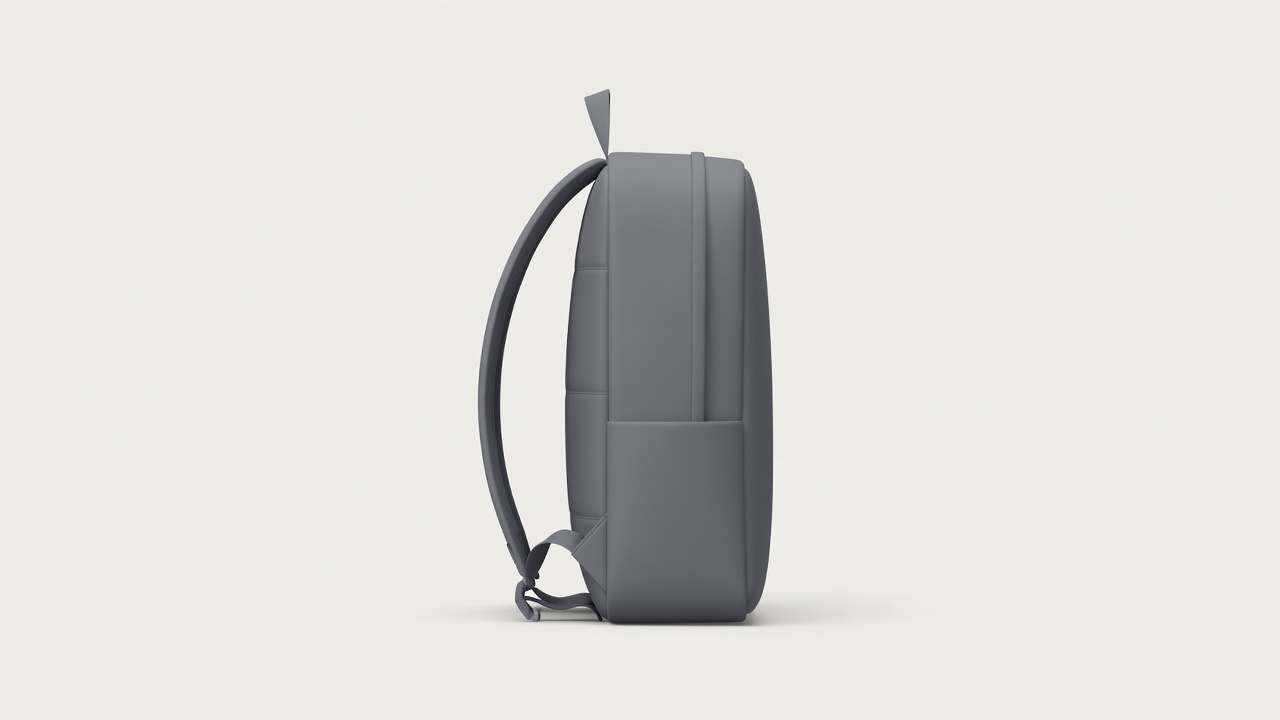
Start with the ordinary journey
Picture a weekday from your front door to your final stop. Perhaps you walk to a station, stand on a train, move through an office and buy groceries on the way home. Each transition asks something different of a backpack. You need stable carry while walking, a manageable footprint in a carriage and enough spare room for the return journey. These needs are more informative than a general label such as “urban” or “adventure”.
Set out everything you usually carry before comparing bags. Include the awkward items: a lunch container, over-ear headphones, a charger with a rigid plug and the jacket that is off your shoulders by lunchtime. Measure the device itself rather than relying on its screen-size label. Protective cases, handles and unusual shapes can change whether a sleeve actually works.
Check comfort under a realistic load
A convincing empty-bag fit can disappear once a laptop and water bottle are inside. If the seller allows it, try the bag with a representative load and walk for long enough to notice pressure. Adjust the straps so the bag sits close without forcing your shoulders backwards. Check that the lower edge does not repeatedly strike your hips and that the top does not catch your neck when you look up.
Wide straps are not automatically comfortable. Their curve, edge binding, attachment angle and padding firmness all affect how pressure is distributed. A sternum strap may reduce sideways movement, but it should not be used to disguise poor shoulder fit. For a short, lightly loaded commute, elaborate load-transfer features may add bulk without solving a real problem.
Keep dense, flat objects close to your back when the bag’s construction supports this. Avoid a hard charger pressing through an unstructured back panel. If you cycle, test your riding posture rather than judging everything upright in a shop. Ventilation channels may improve airflow, but no ordinary padded back panel guarantees a dry shirt.
Choose an opening for where you unpack
A top opening can be convenient in narrow spaces and may accommodate a changing load. Its weakness is visibility: small items can settle beneath larger ones. A panel opening exposes more of the interior and makes packing deliberate, but you may need a clean surface to open it fully. A roll-top offers flexible closure height, though repeated access can take longer than a simple zip.
Compare pocket access with the bag occupied, not empty. A water bottle may intrude into the main compartment; a front pocket can become tight when the bag is full. Put keys and a travel pass somewhere reachable without exposing a laptop to rain or a busy platform. Consider whether any pocket stays accessible while the bag rests on your lap.
Treat capacity as a useful clue
Stated litres help you make an initial shortlist, but they do not tell the whole story. Two bags with similar advertised volume can distribute it differently between the main chamber, sleeves and external pockets. A narrow opening may reject a lunch box that would fit inside. Thick padding can also reduce the space that feels available.
Leave modest room for the additions you actually make: food shopping, an extra layer or work papers. Do not automatically buy for every possible trip. An oversized bag can encourage carrying items you never use and may become awkward when partly filled. For occasional travel, a separate solution may be more practical than compromising your daily comfort.
Separate weather claims from assumptions
Water-resistant fabric is not the same as a waterproof bag. Water can enter through stitching, zip ends, closures and worn coatings. Ask what the manufacturer’s claim covers, whether a test method is named and how the bag should be maintained. An attractive coated exterior alone does not establish protection during prolonged rain.
For sensitive electronics, consider a suitable inner protective layer and keep liquids upright and separate. Let a wet bag dry according to its care instructions before storing it. Avoid assuming that a rain cover solves every exposure problem: fit, wind, uncovered back sections and water running along straps can still matter.
Inspect the likely failure points
Look at strap junctions, the base, zipper ends and buckles. Neat construction is worth noticing, but appearance is not a laboratory durability test. Ask whether a damaged buckle can be replaced without unpicking a major seam and whether the maker offers spare parts or repair assessment. A clear repair policy is more useful than a vague promise that the product is “built for life”.
Finally, check return conditions before trialling the bag outdoors. Keep tags and packaging until you understand the fit. A bag that suits another commuter may not suit your torso, load or route. Choose the least complicated design that carries your real belongings comfortably and lets you reach them when needed.
Useful reference points
Places such as Copenhagen, Stockholm, Oslo and Helsinki offer useful examples of journeys combining walking and public transport, but there is no single “Nordic” body type or packing list. Design history is context, not evidence of fit. For airline travel, consult your carrier’s current allowance; IATA’s baggage guidance explains why carrier-specific checks matter.