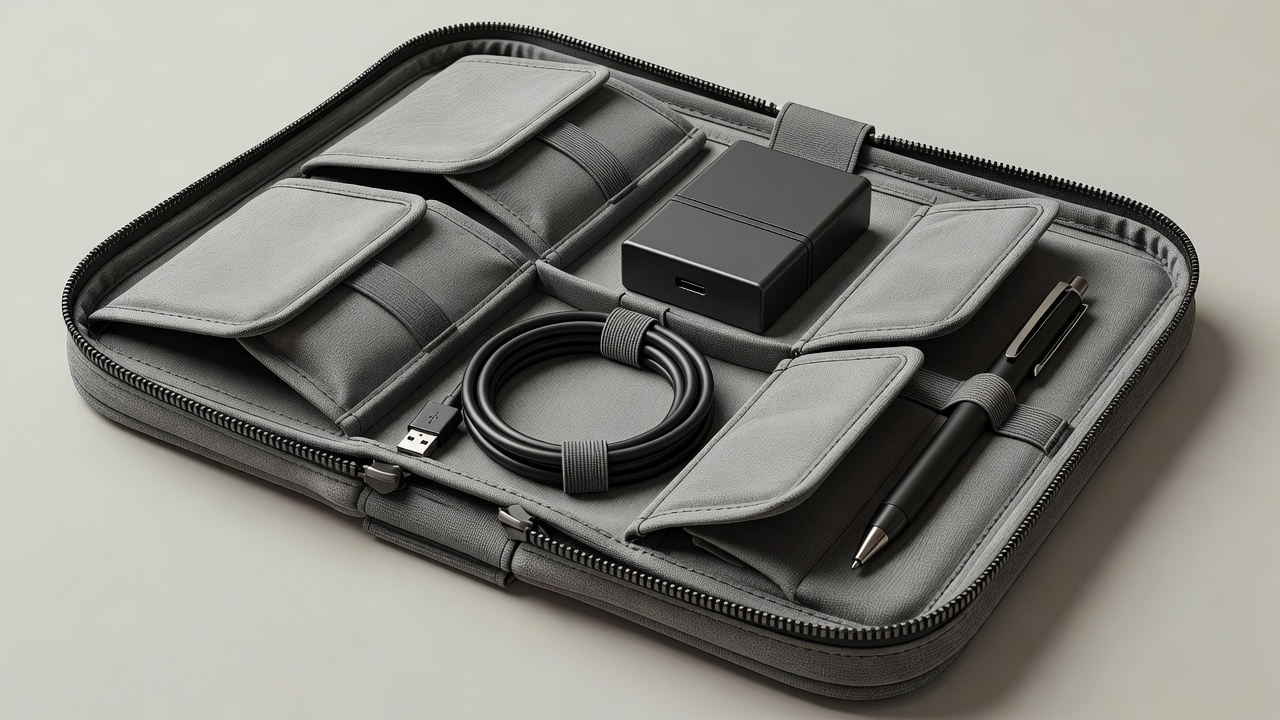
Group by the moment of use
You arrive at a shared desk and need power, a cable and earphones. Those items form a useful task group because they come out together. Your keys and travel pass do not belong in that same pouch simply because they are small. They serve different moments and need quicker access. Organise around repeated actions rather than making every compartment look equally full.
Begin with an inventory on a clear table. Separate daily essentials from occasional extras and items that have simply stayed in your bag. Notice duplicate adapters, expired supplies and cables for devices you no longer use. Removing an unnecessary item is usually a simpler improvement than finding a more elaborate way to store it.
Use the fewest effective layers
A dedicated pouch makes sense when you transfer the same kit between a backpack, work tote and travel bag. It can also stop small hard objects collecting in the bottom of a large compartment. But a pouch inside another pouch, behind an internal zip, creates several barriers to one item. Count the openings between your hand and the object you need.
Built-in organisation may be enough if you use one bag consistently. A removable kit is more flexible if your bag changes with the day. Neither system is inherently better. Test whether you can retrieve the most-used object while standing somewhere ordinary, such as a hallway, rather than while everything is carefully arranged on a desk.
Make a simple access map
Put quick-access items in a shallow, predictable location. Use a separate area for cables and chargers, and protect flat documents from hard corners. Keep liquids away from electronics and account for the consequence of a leaking lid. A tiny container can cause a large problem if its failure affects everything around it.
Leave enough room for your fingers. An organiser that closes only when every object is positioned perfectly may become frustrating during a busy day. Tight elastic loops can suit some items but strain others. Check that plugs do not bear against a zip and that cable ends are not forced into sharp bends.
Prioritise visibility over pocket count
A contrasting lining can make dark objects easier to spot. Mesh shows contents but may catch on protruding parts; opaque fabric hides visual clutter but requires a consistent layout. Small labelled pouches work best when their purpose stays stable. A label reading “desk” is only useful if the contents really support that task.
Pocket quantity does not measure organisation quality. Several narrow slots may be less useful than one open compartment if your charger is bulky. Compare internal dimensions where available and allow for seam allowances, padding and the thickness of the contents. Exterior dimensions alone cannot establish whether an item will fit.
Adapt the kit for light travel
For an overnight journey, build on the daily system instead of automatically starting again. Keep documents, essential medication and the items needed during the journey accessible. Store medication according to its instructions, retain necessary identification and documentation, and consult relevant travel authorities about restrictions. A generic packing guide cannot establish entry permission for a medicine.
Airport rules vary by location, airline and item. A neatly arranged pouch does not make a battery, liquid or tool permissible. Check the departure airport, carrier and destination requirements before packing. If travelling through Copenhagen Airport or Stockholm Arlanda Airport, use the airport’s current security guidance rather than an old social-media packing list.
Give the system a maintenance habit
At the end of the week, empty the organiser and check whether each object still belongs. Look for damaged cable insulation, trapped crumbs, loose pen caps and battery swelling. Stop using damaged electrical equipment; do not treat a pouch as protection against an unsafe device. Follow the device maker’s guidance for inspection, storage and replacement.
Clean the organiser according to its care label. Detergents, heat and vigorous scrubbing can affect coatings, elastic and adhesives. Allow all parts to dry before repacking. If a zipper begins catching, remove the obstruction gently rather than forcing it and turning a small problem into torn fabric or bent teeth.
Run a one-week retrieval test
Use the same layout for several ordinary days. Record what you could not find, what you could not reach and what you never touched. Move the troublesome item before replacing the organiser. If the kit is consistently too bulky, split it by frequency of use: daily essentials in the bag, occasional equipment stored at home or work where appropriate.
The goal is not to achieve a perfect flat-lay photograph. It is to arrive, retrieve what you need and get on with the task. A worn pouch with a clear purpose can be more effective than a new organiser with a pocket for every imagined possibility.