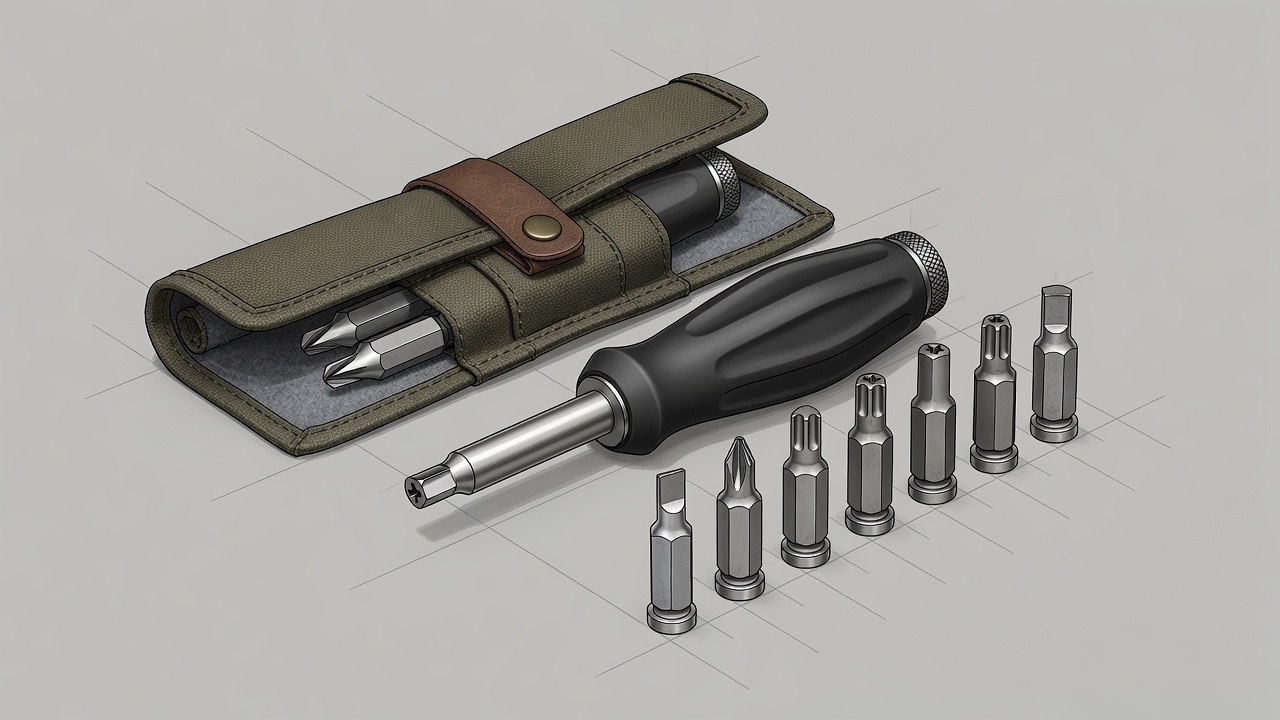
Name the job before the tool
Think back over your recent days. Have you needed to tighten a cabinet handle, adjust a bicycle accessory or open packaging? Those are actual tasks. “Something might happen” is a weaker basis for carrying a heavy collection of implements. Write down the recurring job, the fastener or material involved and where you would realistically perform the work.
A small driver may suit occasional household adjustments better than a complicated multitool. A bicycle-specific kit may be more relevant to a rider than pliers with many unrelated functions. Some commuters need no portable tool at all. Equipment already available at home, work or a repair point can be a better answer than duplicating it in your bag.
Check the working end and the handle
A driver must fit the fastener accurately. Phillips, Pozidriv, Torx and hex profiles are not interchangeable simply because a bit appears to enter the recess. The correct size matters as much as the general shape. A poor fit can damage the fastener and make the original problem harder to repair.
Reach matters too. A short folding implement may not access a recessed screw, while a thick handle may prevent a straight approach. Check the relevant equipment manual before applying force. If a manufacturer specifies a torque, a small hand tool is not a substitute for suitable torque-controlled equipment and the knowledge to use it.
Comfort becomes a safety issue when the handle digs into your hand or the implement folds unexpectedly. Read the instructions for opening, locking and closing. Keep fingers clear of joints and pinch points. A tool that looks compact on a keyring can be awkward when attached keys obstruct your grip.
Understand what a compact tool cannot do
Portable tools trade leverage, reach and handle comfort for size. Do not extend a handle with an improvised pipe, strike an implement not designed for impact or use a blade as a pry bar. A small tool is not an invitation to attempt a larger job with more force. If something resists unexpectedly, stop and establish why.
Avoid work on live electrical equipment. Safety-critical bicycle, vehicle or structural repairs require the correct procedures, parts and competence. If you are uncertain, consult a qualified repairer. Carrying a tool can help with a simple adjustment, but it does not create the skill or permission required for every repair.
Check the whole route for restrictions
Tools can be restricted by local law, workplace policy, venue rules and transport security requirements. A blade-free design is not a universal permission slip. Locking mechanisms, sharp points, tool dimensions and intended use may all affect how an item is treated. Rules can also differ between carrying an object in public and transporting it securely for a legitimate task.
Before flying, check the exact item against the departure authority’s rules, the airline’s conditions and requirements at connecting airports. Do not rely on the phrase “travel friendly” on a shop page. For journeys involving the United States, the Transportation Security Administration’s item guidance is a starting point, not a guarantee that an item will be accepted in every circumstance.
For UK travel, use the current GOV.UK hand-luggage guidance and consider separate legal restrictions on carrying knives. For Denmark, Sweden, Norway or Finland, consult the relevant local authorities rather than transferring a rule from another country. This guide is not legal advice.
Carry it without creating a new problem
Protect sharp or pointed parts with a suitable closed sheath or case. Keep a tool from rubbing against a laptop, puncturing a bottle or collecting dirt inside a charging port. A dedicated pocket can help, but it should hold the item securely rather than allowing it to escape when you open the bag.
Weight at the end of a keyring is easy to underestimate. It can swing, scratch nearby surfaces and make keys less comfortable in a pocket. Store a tool separately if that improves access and control. Do not leave tools accessible to children or others who may handle them without understanding the risks.
Inspect before relying on it
Look for corrosion, damaged edges, loose joints and bits that no longer seat properly. Clean and maintain the tool according to its manufacturer’s instructions, using only appropriate lubricants and methods. Do not assume that a maintenance method suitable for an all-metal implement is suitable for a tool containing polymer parts, adhesives or electronics.
After using the kit, replace missing consumables and return the correct bits to their places. If you carry it for bicycle adjustments, verify compatibility with your own bicycle rather than a generic packing list. A compact kit with the right pieces is more useful than a larger one that lacks the one interface you encounter.